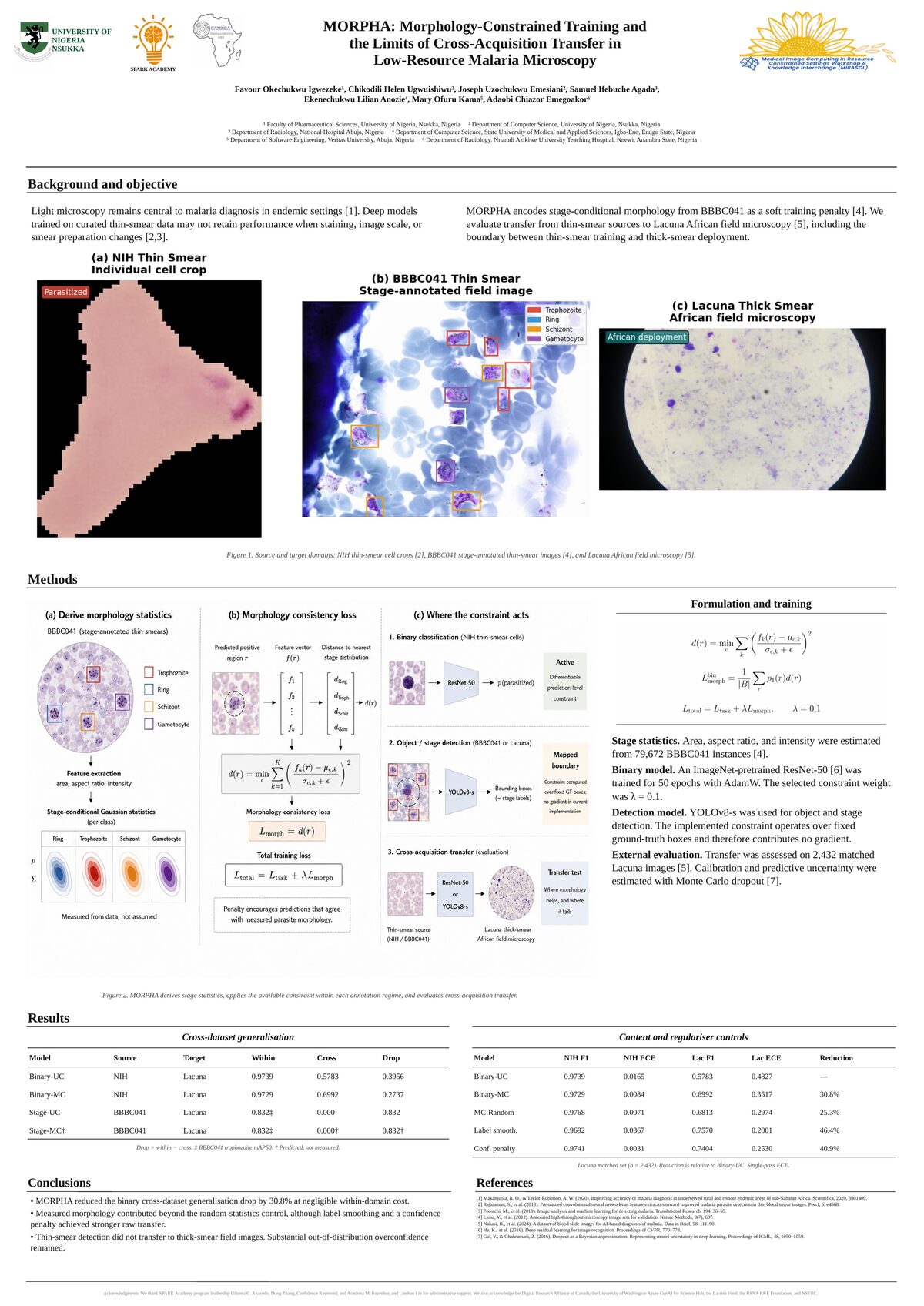
MORPHA: Morphology-Constrained Training and the Limits of Cross-Acquisition Transfer in Low-Resource Malaria Microscopy
arXiv:2609.05990 · Accepted at MIRASOL @ MICCAI 2026 · Springer LNCS proceedings forthcoming
We introduce a morphology-grounded consistency constraint that improves thin-to-thick-smear classification transfer and calibration, while mapping where acquisition shift defeats detection and pseudo-labelling.
Bib
BibTeX
@misc{igwezeke2026morpha,
  title         = {{MORPHA}: Morphology-Constrained Training and the Limits of Cross-Acquisition Transfer in Low-Resource Malaria Microscopy},
  author        = {Igwezeke, Favour Okechukwu and Ugwuishiwu, Chikodili Helen and Emesiani, Joseph Uzochukwu and Agada, Samuel Ifebuche and Anozie, Ekenechukwu Lilian and Kama, Mary Ofuru and Emegoakor, Adaobi Chiazor},
  year          = {2026},
  eprint        = {2609.05990},
  archivePrefix = {arXiv},
  primaryClass  = {cs.CV},
  doi           = {10.48550/arXiv.2609.05990},
  note          = {Accepted for poster presentation at MIRASOL 2026, a MICCAI 2026 workshop},
  url           = {https://arxiv.org/abs/2609.05990}
}
Abstract
Abstract
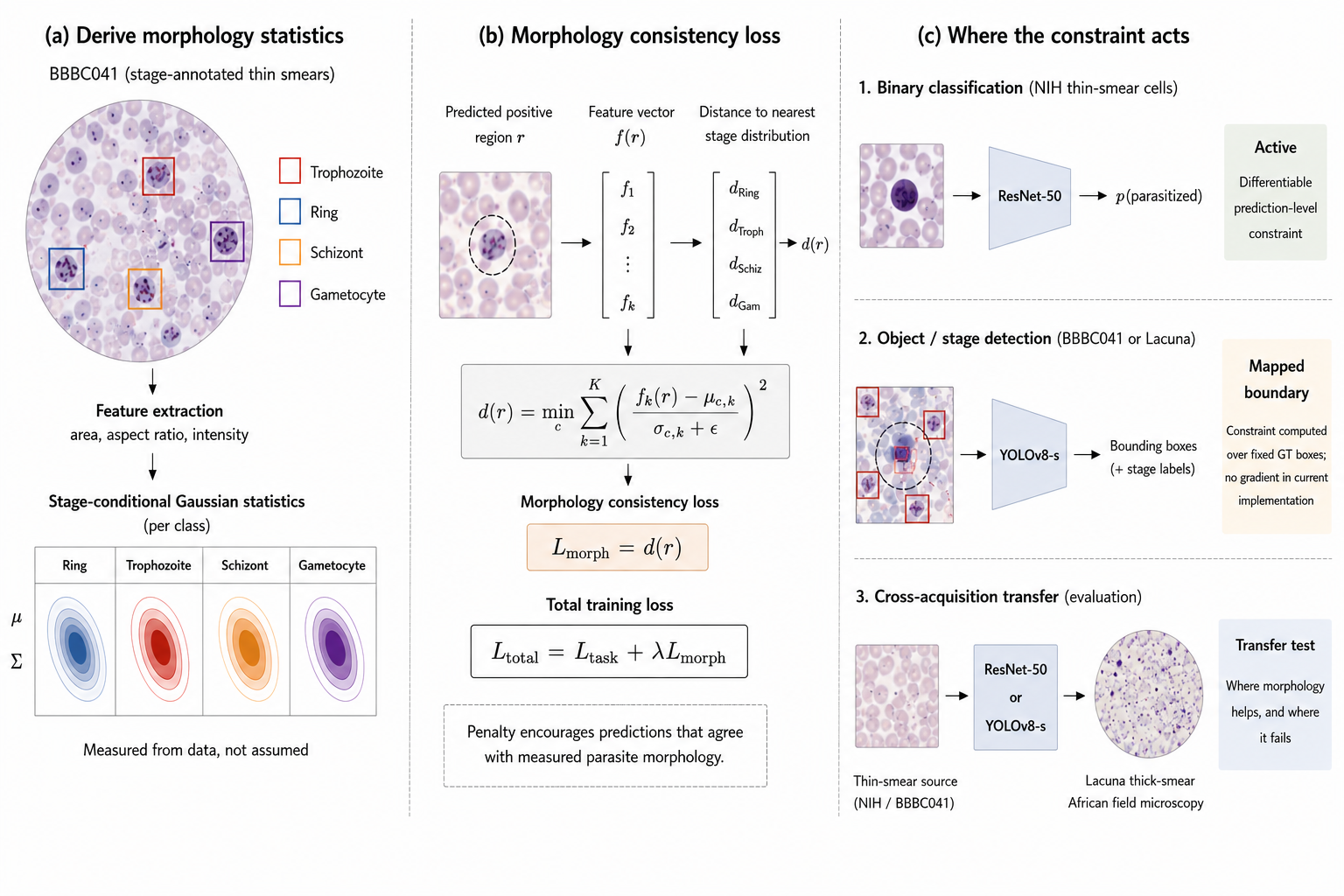
MORPHA encodes stage-conditioned morphology statistics from BBBC041 as a soft training constraint and evaluates the same idea across binary classification, detection, and stage-aware malaria microscopy under transfer from thin-smear sources to Lacuna field images from Uganda.
For binary classification, the constraint improves Lacuna F1 from 0.5783 to 0.6992 and reduces in-distribution calibration error with negligible source-domain cost. Content-free controls show that measured morphology contributes to the gain, although generic confidence regularisers transfer better. Detection and pseudo-labelling fail across the acquisition boundary, showing that thin-smear benchmarks cannot stand in for thick-smear deployment.